
Last time we looked at Kendig‘s first definition of multiplicity. A branch of E, parametrized by (xE(t),yE(t)), passes through the origin O, as does the curve F. Assume xE(t) and yE(t) are power series in t. Plug them into the polynomial F(x,y), getting a power series F(t). The order of F(t) (the degree of the first nonzero term) is the multiplicity of that intersection—that is, of the branch of E with the entire curve F at O.
Algebraic Geometry Jottings 3
Bézout’s theorem requires us to count intersection points according to their multiplicity. OK, what’s multiplicity? (Fulton uses the phrase intersection number.)
Filed under Algebraic Geometry
Algebraic Geometry Jottings 2
As I said last time, I’m learning some algebraic geometry, starting with Bézout’s theorem, and using Fulton’s Algebraic Curves and Kendig’s A Guide to Plane Algebraic Curves as the texts. Right now we’re looking at this example from Fulton:
Filed under Algebraic Geometry
Algebraic Geometry Jottings 1
I’ve decided to learn algebraic geometry. Or at least more algebraic geometry—I’m not starting from zero. But I’m still sampling the appetizers; I’m using Fulton’s Algebraic Curves and Kendig’s A Guide to Plane Algebraic Curves as my initial texts. Eventually I’d like to understand schemes, but that’s dessert; I plan on making a long, leisurely meal of it, with plenty of time savoring examples and history, and chewing proofs to extract all the flavor. (Can you tell I’m writing this before lunch?)
Filed under Algebraic Geometry
A Fragment From the Archives
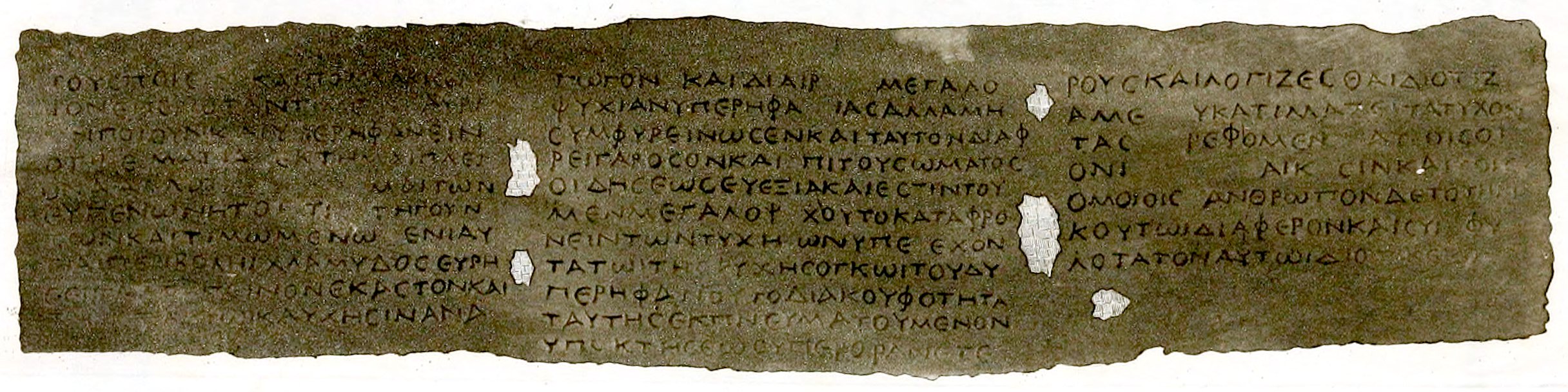
The ancient Greeks grappled in vain with three geometrical problems: the duplication of the cube, the trisection of the angle, and the squaring of the circle. What drove them to these endeavors? Divine inspiration? Well, yes—of a sort. The origin of the duplication of the cube is well-known. The story behind the trisection of the angle however has been lost to history—until now.
Filed under Bagatelles
Non-standard Models of Arithmetic 14
MW: Recap: we showed that PAT implies ΦT, where ΦT is the set of all formulas

Now we have to show the converse, that PA+ΦT implies PAT. But first let’s wave our hands, hopefully shaking off some intuition, like a dog shaking off water.
Filed under Conversations, Peano Arithmetic
Year Zero
Awhile back, the BBC website History Extra had a post that included this tidbit:
AD 0… the date that never was
The AD years of the Christian calendar are counted from the year of Jesus Christ’s birth, and, as the number zero was then unknown to the west, Dionysius began his new Christian era as AD 1, not AD 0. …
This evoked the ire of the noted historian Thony Christie. In a post Something is Wrong on the Internet, he explained:
Filed under Bagatelles, History
Non-standard Models of Arithmetic 13
MW: OK, back to the main plotline. Enayat asks for a “natural” axiomatization of PAT. Personally, I don’t find PAT all that “unnatural”, but he needs this for Theorem 7. (It’s been a while, so remember that Enayat’s T is a recursively axiomatizable extension of ZF.)
Filed under Conversations, Peano Arithmetic
First-Order Categorical Logic 6
MW: An addendum to the last post. I do have an employment opportunity for one of those pathological scaffolds: the one where B(0) is the 2-element boolean algebra, and all the B(n)’s with n>0 are trivial. It’s perfect for the semantics of a structure with an empty domain.
The empty structure has a vexed history in model theory. Traditionally, authors excluded it from the get-go, but more recently some have rescued it from the outer darkness. (Two data points: Hodges’ A Shorter Model Theory allows it, but Marker’s Model Theory: An Introduction forbids it.)
Filed under Categories, Conversations, Logic
First-Order Categorical Logic 5
JB: Okay, let me try to sketch out a more categorical approach to Gödel’s completeness theorem for first-order theories. First, I’ll take it for granted that we can express this result as the model existence theorem: a theory in first-order logic has a model if it is consistent. From this we can easily get the usual formulation: if a sentence holds in all models of a theory, it is provable in that theory.
Filed under Categories, Conversations, Logic


 Diagonal Argument