
This will be a “chewing” post.
Author Archives: Michael Weiss
Algebraic Geometry Jottings 7
Fulton characterizes the intersection number, I(P, E∩F), with seven properties. Let me just repeat the last one:
- I(E∩F) = I(E∩(F+AE)) for any A.
Filed under Algebraic Geometry
Algebraic Geometry Jottings 6
The tome Commutative Algebra by Zariski and Samuel opens with the memorable sentence, “This book is the child of an unborn parent.” As Zariski explains,
Filed under Algebraic Geometry
Algebraic Geometry Jottings 5
We’ve been looking at Kendig‘s two definitions of intersection multiplicity; now let’s look at Fulton‘s.
Fulton characterizes the multiplicity I(E∩F) with seven properties (§3.3). (Fulton calls it the intersection number. Also, he writes I(P,E∩F) for the intersection number at P. I’ll usually assume P is the origin O, and omit writing it.) The last three properties stand out:
Filed under Algebraic Geometry
Algebraic Geometry Jottings 4
Last time we looked at Kendig‘s first definition of multiplicity. A branch of E, parametrized by (xE(t),yE(t)), passes through the origin O, as does the curve F. Assume xE(t) and yE(t) are power series in t. Plug them into the polynomial F(x,y), getting a power series F(t). The order of F(t) (the degree of the first nonzero term) is the multiplicity of that intersection—that is, of the branch of E with the entire curve F at O.
Filed under Algebraic Geometry
Algebraic Geometry Jottings 3
Bézout’s theorem requires us to count intersection points according to their multiplicity. OK, what’s multiplicity? (Fulton uses the phrase intersection number.)
Filed under Algebraic Geometry
Algebraic Geometry Jottings 2
As I said last time, I’m learning some algebraic geometry, starting with Bézout’s theorem, and using Fulton’s Algebraic Curves and Kendig’s A Guide to Plane Algebraic Curves as the texts. Right now we’re looking at this example from Fulton:
Filed under Algebraic Geometry
Algebraic Geometry Jottings 1
I’ve decided to learn algebraic geometry. Or at least more algebraic geometry—I’m not starting from zero. But I’m still sampling the appetizers; I’m using Fulton’s Algebraic Curves and Kendig’s A Guide to Plane Algebraic Curves as my initial texts. Eventually I’d like to understand schemes, but that’s dessert; I plan on making a long, leisurely meal of it, with plenty of time savoring examples and history, and chewing proofs to extract all the flavor. (Can you tell I’m writing this before lunch?)
Filed under Algebraic Geometry
A Fragment From the Archives
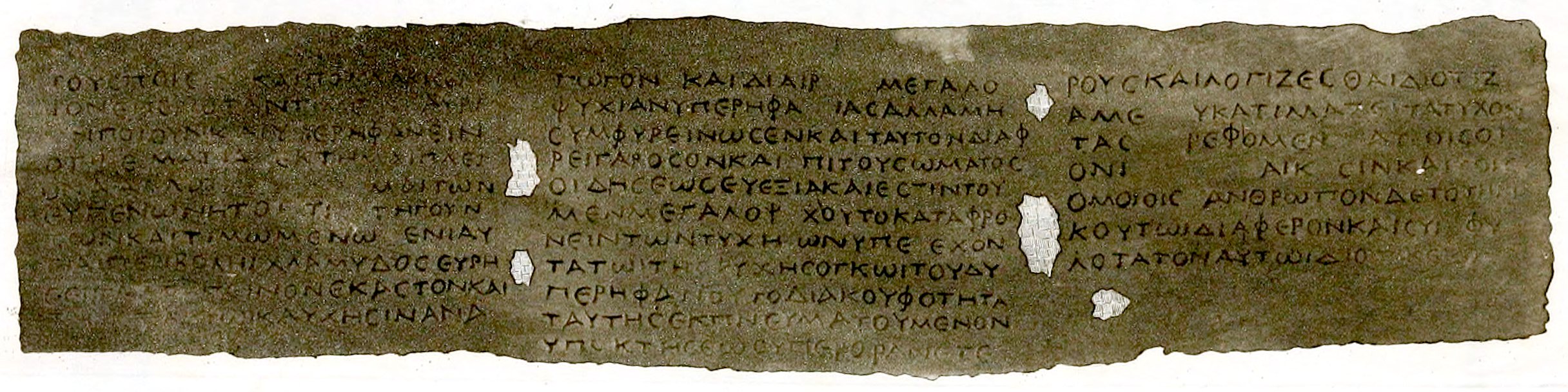
The ancient Greeks grappled in vain with three geometrical problems: the duplication of the cube, the trisection of the angle, and the squaring of the circle. What drove them to these endeavors? Divine inspiration? Well, yes—of a sort. The origin of the duplication of the cube is well-known. The story behind the trisection of the angle however has been lost to history—until now.
Filed under Bagatelles
Non-standard Models of Arithmetic 14
MW: Recap: we showed that PAT implies ΦT, where ΦT is the set of all formulas

Now we have to show the converse, that PA+ΦT implies PAT. But first let’s wave our hands, hopefully shaking off some intuition, like a dog shaking off water.
Filed under Conversations, Peano Arithmetic


 Diagonal Argument