
MW: Ok, let’s plunge into the construction of Trued(x). The bedrock level: True0(x), truth for (closed) atomic formulas. Continue reading
Non-standard Models of Arithmetic 15
The Truth about Truth
MW: A little while back, I noted something delicious about the history of mathematical logic:
- Gödel’s two most famous results are the completeness theorem and the incompleteness theorem.
- Tarski’s two most famous results are the undefinability of truth and the definition of truth.
Filed under Conversations, Peano Arithmetic
Algebraic Geometry Jottings 18
Up till now, I’ve been using power series to parametrize branches:
x(t) = a0+a1t+a2t2+ ⋯, y(t) = b0+b1t+b2t2+ ⋯
If the branch passes through the origin, then a0=b0=0. In the last post, we established Facts 4 and 5, assuming that y(t)=t for all branches, so x(t) = a0+a1y+a2y2+ ⋯.
Filed under Algebraic Geometry
Algebraic Geometry Jottings 17
At last we come to Kendig’s proof of Bézout’s Theorem. Although not long, it will take me a few posts to appreciate it in full.
Filed under Algebraic Geometry
Algebraic Geometry Jottings 16
The Resultant, Episode 5: Inside the Episode
The double-product form for the resultant:

implies Fact 3:
Filed under Algebraic Geometry
Algebraic Geometry Jottings 15
The Resultant, Episode 5 (The Finale)
Recap: The setting is an integral domain R, with fraction field K, and extension field L of K in which E(x) and F(x) split completely. E(x) and F(x) have coefficients in R. E(x) has degree m, F(x) degree n; we assume m,n>0. The main special case for us: R=k[y], K=k(y), so R[x]=k[x,y], and E and F are polynomials in x and y. As always, we assume k is algebraically closed.
Filed under Algebraic Geometry
Algebraic Geometry Jottings 14
The Resultant, Episode 4
This episode has one sole purpose: to show that the two formulas for the resultant are equivalent. The next episode, the finale, will tie up some loose ends.
Filed under Algebraic Geometry
Weierstrass’s Smackdown of Dirichlet’s Principle
In 1856 Dirichlet made the following claim in a lecture:
The Monoenergetic Heresy (Part 1)

The Emperor Heraclius.
Classical Numismatic Group, Inc. Wikimedia Commons
And now for something completely different.
Filed under Bagatelles, History
Escher’s Toroidal Print Gallery
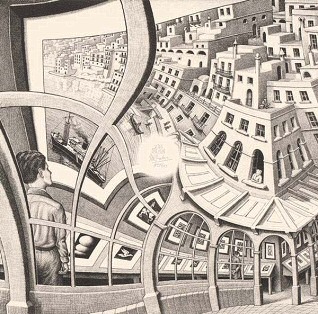
Prentententoonstelling
(From Wikimedia Commons)
If Art+Math brings one person to mind, it’s Escher. His tessellations present the best-known instance, but he did a lot more than that.
In April 2003, the mathematicians Bart de Smit and Hendrik Lenstra wrote a delightful article, Escher and the Droste effect, about Escher’s lithograph Prentententoonstelling. They pointed out that
We shall see that the lithograph can be viewed as drawn on a certain elliptic curve over the field of complex numbers…


 Diagonal Argument
