
I’ll begin with Kepler’s first two laws, and work backwards to Ptolemy’s system. Seeing Keplerian astronomy recast this way will expose the bones of the Ptolemaic system.
Deferents and Epicycles
I’ll begin with Kepler’s first two laws, and work backwards to Ptolemy’s system. Seeing Keplerian astronomy recast this way will expose the bones of the Ptolemaic system.
Deferents and Epicycles
Quite some time ago I started writing up notes, for my own amusement, on the history of astronomy. I’ve worked on it on-an-off over the years, but there always seems to be a bit more I should add. Eventually the pdf version will be ready for prime time. Meanwhile I’ve decided to convert what I have into a series of posts. Enjoy!
Filed under History Book Club
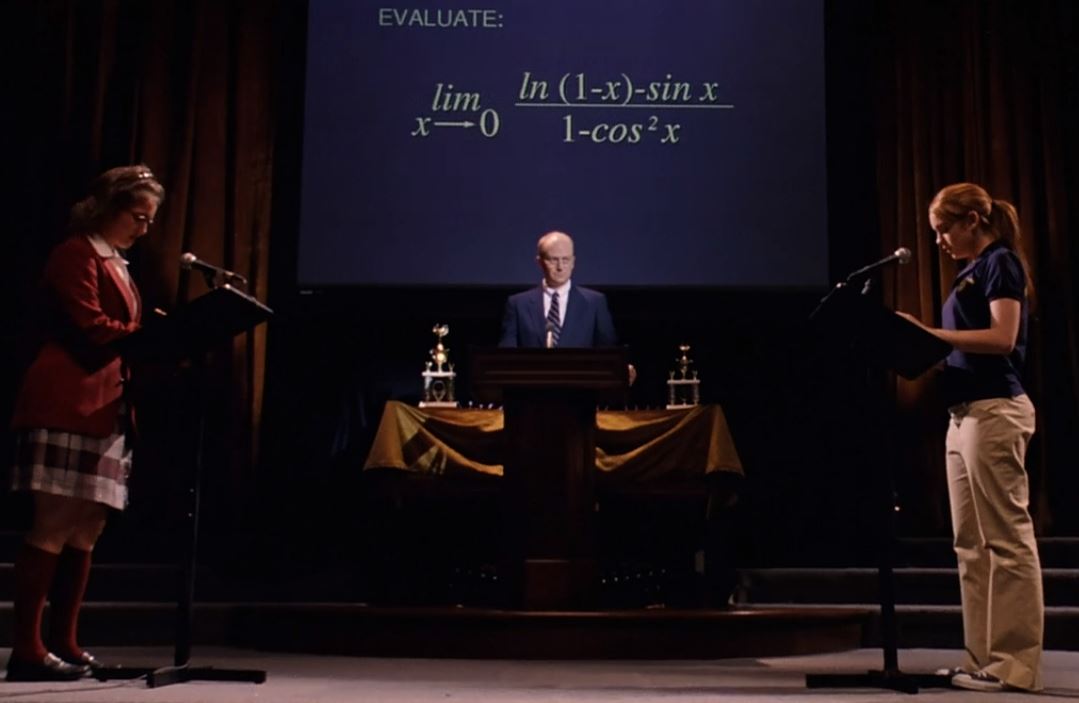
Here it is:
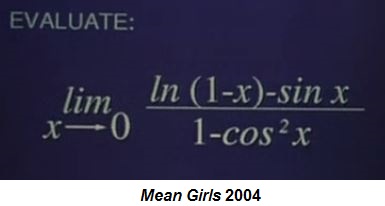
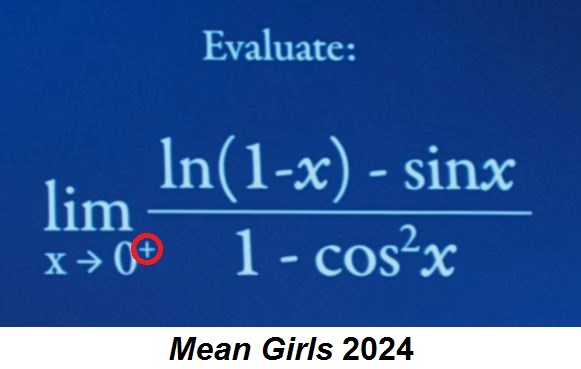
Apparently two-sided limits are problematic in 2024.
Filed under Bagatelles, Math
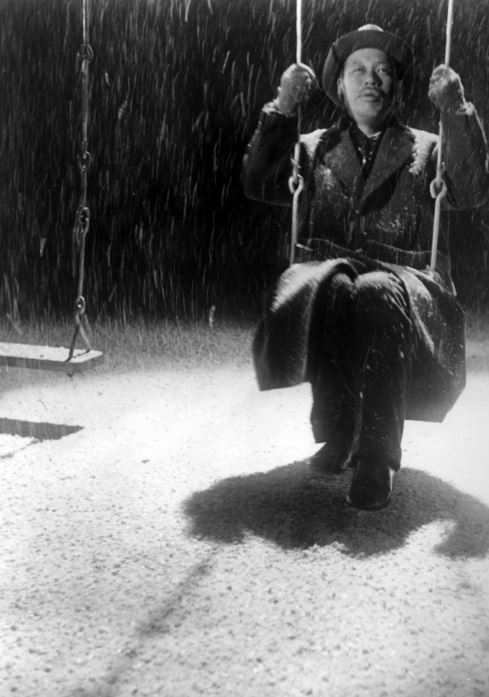
Still from Ikiru
Another post from the History Book Club, based on:
Filed under History, History Book Club
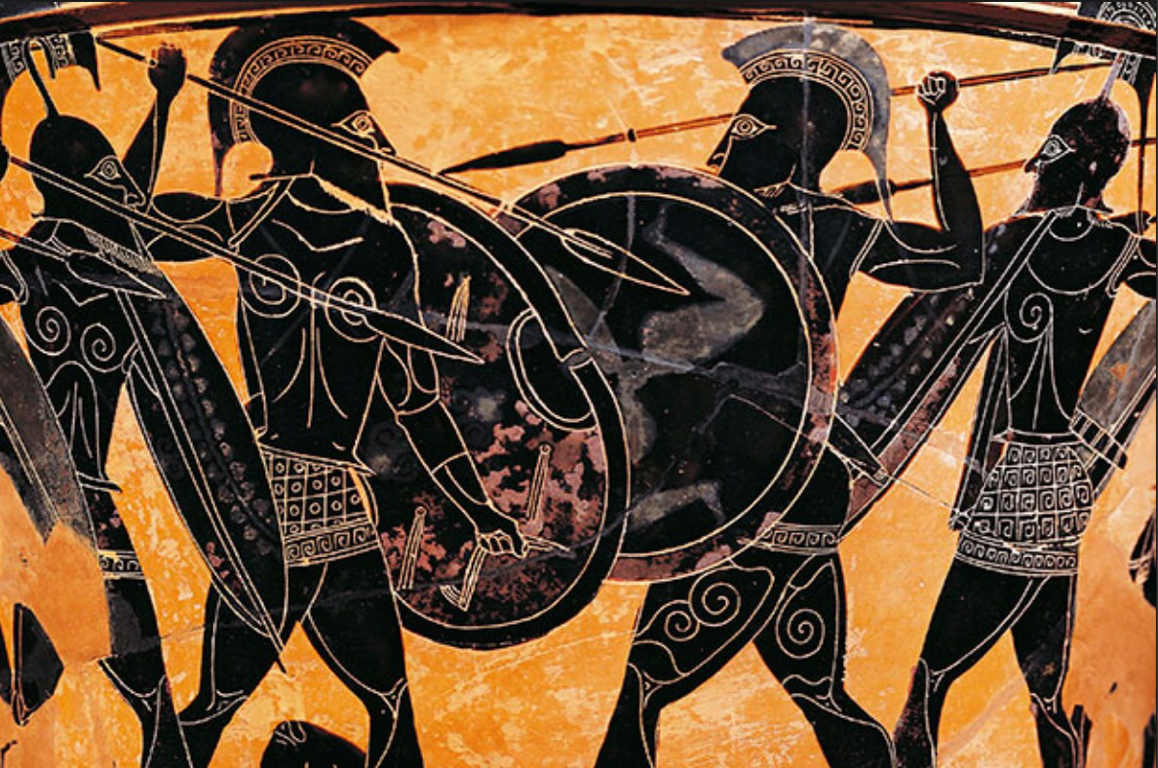 Another post from the History Book Club.
Donald Kagan: Ancient Greek History; The Peloponnesian War
Filed under History, History Book Club
Intro: The Cage Match
Do heavier objects fall faster?
Once upon a time, this question was presented as a cage match between Aristotle and Galileo (Galileo winning). As Carlo Rovelli puts it:
…[Aristotle’s physics] is commonly said to state that heavier objects fall faster when every high-school kid should know they fall at the same speed. (Do they??)
and Thony Christie at The Renaissance Mathematicus says:
As is generally well known, having defined fall as natural motion, Aristotle now goes on to elucidate his laws of fall, which, of course, everybody knows were wrong being first brilliantly corrected by Galileo in the seventeenth century. Firstly, Aristotle’s laws of fall are not as wrong as people think, and secondly, they were, as we shall see in later episodes, challenged and corrected much earlier than Galileo.

In Part 1, I mentioned my (momentary) discombobulation when I learned about the 6th century Monoenergetic Heresy—long before ‘energy’ entered the physics lexicon. What’s going on? But as I said, “Of course you know the answer: Aristotle.”
Over the years, I’ve dipped in Aristotle’s works several times. Caveat: I’m a dilettante here. Or to borrow the disclaimer that used to grace horoscope columns, what follows is “for entertainment purposes only”.
Aristotle, Weight Loss Guru Continue reading
Filed under Aristotle, Bagatelles, History
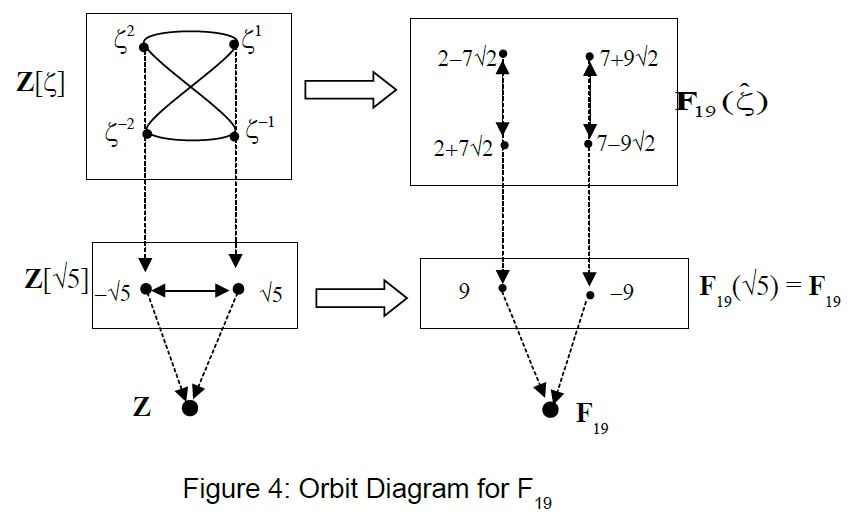
Quadratic reciprocity has hundreds of proofs, but the nicest ones I’ve seen (at least at the elementary level) use Gauss sums. One variant uses the cyclotomic field ℚ(ζ), where ζ is a p-th root of unity. Another brings in the finite fields 𝔽p and 𝔽q.
I wrote up a long, loving, and chatty treatment several years ago, going through the details for several examples. Much longer than the proofs! The diagram up top may give you an inkling.
Anyway, here it is.
Filed under Number Theory
MW: Last time we learned about the “back-and-forth” condition for two countable structures M and N for a (countable) language L:
Filed under Conversations, Peano Arithmetic



 Diagonal Argument