
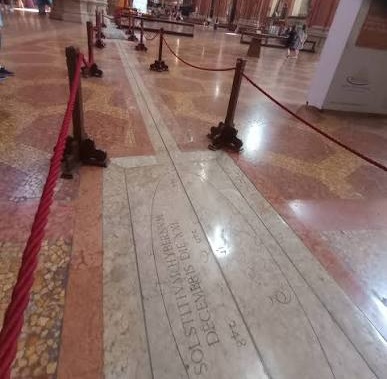
The heliometer (meridian line) at the Basilica of San Petronio
Earth’s Orbit
Ptolemy’s solar model gives the sun an eccentric orbit, with uniform speed—no equant. Both Copernicus and Tycho adopted the uniform speed for the earth’s/sun’s orbit. As a consequence, they end up with twice the correct eccentricity. (See post 8.)
The Ptolemaic system further disguises the earth’s orbit as the epicycles of the outer planets and the deferent of Venus. (Mercury is sui generis.) The epicycles have neither equants nor eccentricities, which amounts to giving the earth uniform speed in a Sun-centered circular orbit. Venus’s deferent has both an eccentric circle and an equant.
Kepler of course would have none of this. No special treatment for the earth! He gave it an equant, with the center of the orbit situated midway between the equant and the true sun. So Kepler assigned the earth half its former eccentricity. This is known as the “bisection of eccentricity”.
How does this matter for Mars? Earth is our observing platform. If you are mistaken about your own celestial position, you will inevitably screw up how you interpret the data.
Kepler devised an ingenious triangulation scheme to determine the earth’s orbit. Mars has a period of 687 days. Observations separated by that interval thus involve Earth-Mars vectors from the variable position of the earth to a fixed position for Mars. Mentally reversing the direction of the vector gives us essential information about the earth’s orbit. I will look at how Kepler used this insight below. First, though, some more historical context.
Voelkel writes:
Kepler undertook to write the Astronomia nova in October or November 1602, long before the discovery of the ellipse and elucidation of the area law… At the time he resolved to write the book, he had written to Herwart von Hohenburg that his work on Mars had allowed him to solve the problem of the orbit of the sun (or earth). And in many ways, the Astronomia nova was as much about the earth’s orbit as it was about Mars’s orbit. [Voelkel (p.212)]
Kepler develops his theory of the earth in the first few chapters of Part III. Part II contains the vicarious hypothesis. In fact, this almost inverts the timeline. Not only the zeroth law, but the whirlpool force hypothesis pushed Kepler to investigate the earth’s orbit.
Presenting the vicarious hypothesis first served a rhetorical purpose. Kepler could say, “See? I tried to make the traditional scheme work. The failure of my Imitation of the Ancients, and the way in which it failed, indicate that there is something amiss with the existing model of Earth’s orbit.”
This innovation with the earth’s orbit met with considerable resistance. Tycho disliked it, as did Kepler’s pen pal Fabricius. Tycho felt, “If it ain’t broke, don’t fix it!” Likewise Fabricius, who wrote, “We ought not heedlessly to depart from Tycho’s well-developed solar hypothesis.” As Voelkel puts it:
…this unprecedented innovation, clashing as it did with Tycho’s solar theory and meeting Fabricius’s deep skepticism, needed an unusually sure foundation, especially because it was the ultimate justification for his physical astronomy. [Voelkel (p.236)]
The disapproval lasted—more so than for the elliptical orbit. The astronomer Giovanni Cassini, using a so-called heliometer (aka meridian line) at the Basilica of San Petronio, finally confirmed Kepler’s bisection in 1655. Heilbron (p.102–112) recounts the story. He writes:
Many astronomers objected to a solar equant. Thus began what Flamsteed, writing a generation after its resolution, called a “controversy … of no small moment”. It was this great and obscure controversy between adherents of Ptolemy’s traditional solar theory and proponents of Kepler’s “bisection of the eccentricity”, with its Copernican associations, that Cassini proposed to settle at San Petronio.
…to put the point in a few words (they are those of Astronomer Royal Flamsteed), “the Suns Excentricity is bisected as the Copernicans affirme.” This connection of ideas—the bisection of the eccentricity implies that the earth is a planet—became commonplace among Copernicans.
The Great Martian Catastrophe
In 1593 Tycho observed Mars. It was in the wrong position, by about 10 Moon diameters! The Ptolemaic and Copernican tables gave longitudes differing by about 5°, in opposite directions. The values remained off for several weeks. Gingerich called this “The Great Martian Catastrophe”.
Fixing the earth’s orbit reduced the size of the “great Martian catastrophe” tenfold. Specifically, it reduced the maximum longitudinal discrepancy from about 5° to about 0.5°, or 30′. Kepler’s area speed law plus the elliptical orbit reduced it further to about 2′.
Other simplification flowed from the modified earth’s orbit. Kepler called it “the Key to a Deeper Astronomy”.
The Two Methods
OK, now let’s look at how Kepler determined the position of Earth’s equant. The old theory had the earth move uniformly around the center of the orbit, which is displaced from the sun. Effectively, this makes the equant and the center identical. Kepler replaced this with the center midway between the sun and the equant. The figure below illustrates the first method, from Chapters 22 and 23. In Chapter 22 he shows that the equant is not the same as the center.
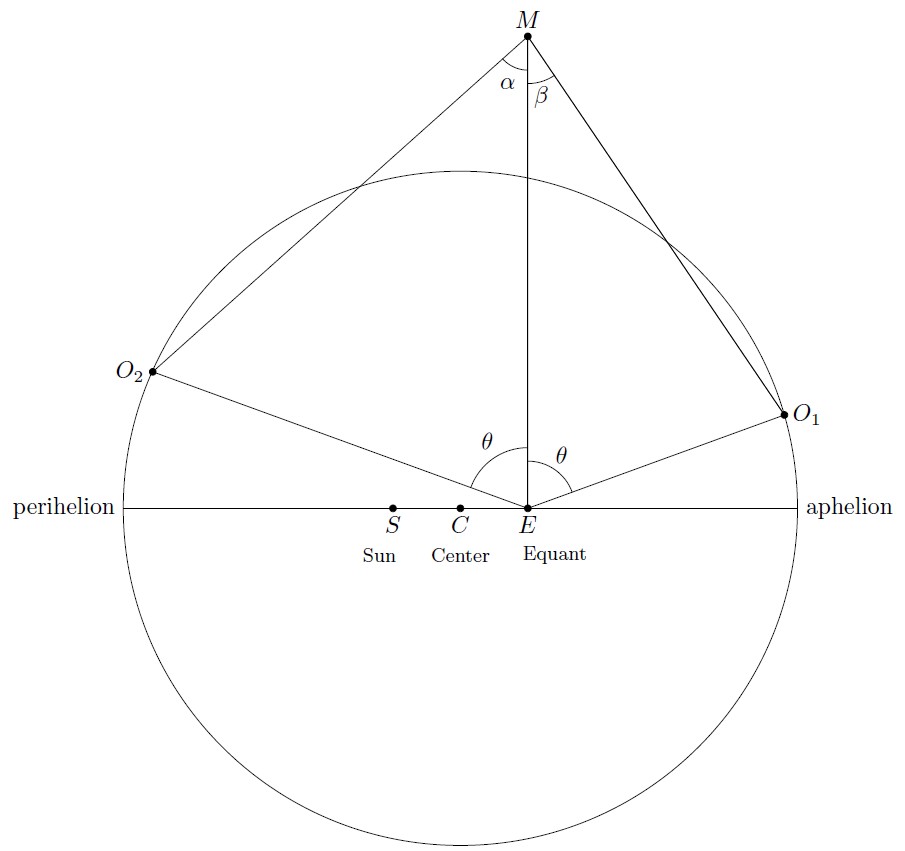
Earth’s Orbit: First Method
In the figure, S, C, and E are the sun, the center, and the equant; and O1 and O2 are two positions of the earth. Recall his triangulation trick: if the time interval between O1 and O2 is a multiple of 687 days, then Mars will occupy the same position M both times. The times of O1 and O2 are chosen so that the two angles θ are equal. Since motion is uniform about the equant, angles about the equant are measured by times. If O1 and O2 are separated by equal times from the aphelion and perihelion respectively, then the two angles will be equal.
Kepler also needed the line EM to be perpendicular to the line of apsides (the diameter in the figure). Again this is achieved by picking the right epochs. Altogether, this method requires observations at very particular times. We see the importance of Tycho’s treasure trove.
Now suppose that E and C were the same. Then the diagram would be symmetrical about the line EM, and angles α and β would be equal. (Mentally slide the line EM left until E coincides with C.) But Kepler found that α exceeded β by more than one degree. “Witness the great difference” he exclaimed.
In Chapter 23 he computes the relative positions of S, C, and E. The directions O1M and O2M are known from observation. That gives us the angles α and β. The times of the observations give him the angle θ (see above). So all relevant angles are known. I won’t go through the intricate trigonometry that computes the position of E in the line of apsides from this data. But intuitively, it is clear it uniquely determines the position: sliding E from perihelion to aphelion continuously increases α up from zero and decreases β down to zero, so there is exactly one spot where they have the right values.
Kepler found that the eccentricity (CE over the orbital radius) was 0.01834. Tycho’s value for the eccentricity was 0.03584. Half that is 0.01792, close enough to 0.01834. The bisection of eccentricity confirmed!
Chapter 24 sets out with the bold declaration, “Now that we have once made a hazard of this, we are buoyed by audacity and will begin to move more free on this battlefield.” Kepler proposes to take triplets of observations, separated by multiples of 687 days, and from them find the distances of the equant to three points of the orbit. Three points determine a circle. “If a fourth observation will be at hand, it will serve as a test.”
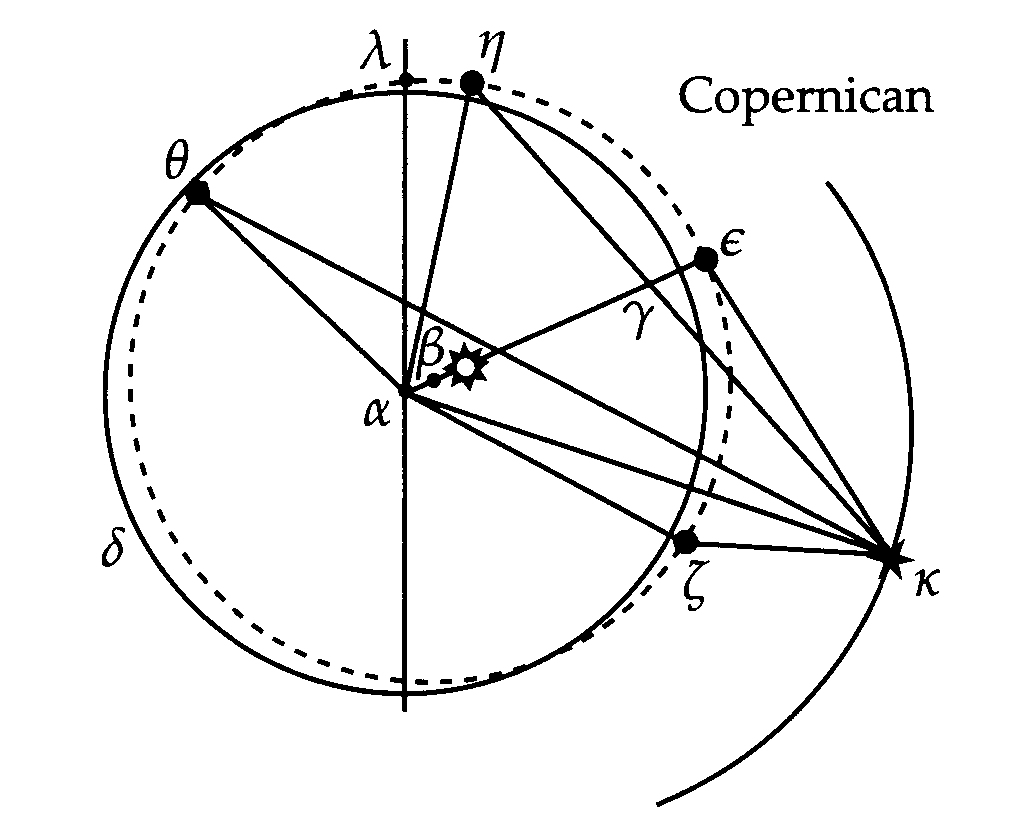
Earth’s Orbit: Second Method
The figure above reproduces the diagram from Chapter 24. Here κ is the fixed position of Mars. The variable Earth positions are θ,η,ε,ζ. The dashed circle is the earth’s new orbit, with the new center β bisecting the eccentricity.
The observations give the Earth-Mars directions θκ, ηκ, εκ, and ζκ, but not the distances. Earth-Equant directions are given by the times (because uniform motion). Mars-Equant directions are given by Tycho’s theory of Mars (or by the vicarious hypothesis). Consider an Earth-Equant-Mars triangle, such as △ηακ. We have all the directions, and thus all the angles. The law of sines tells us all ratios of sides. In particular, it gives us the distance αη in terms of ακ. We have this for all four Earth positions, which means we have the distances αθ, αη, αε, αζ in terms of some common unit. (For another exposition of this material, see Stephenson (pp.53–55), Voelkel (pp.105–106), or Donahue (pp.45–50).)
The distances differed, again disproving the identity of the equant with the center. The results once more agreed with the bisection of eccentricity. Kepler now had empirical proof of one of his deductions from his whirlpool force hypothesis.


