
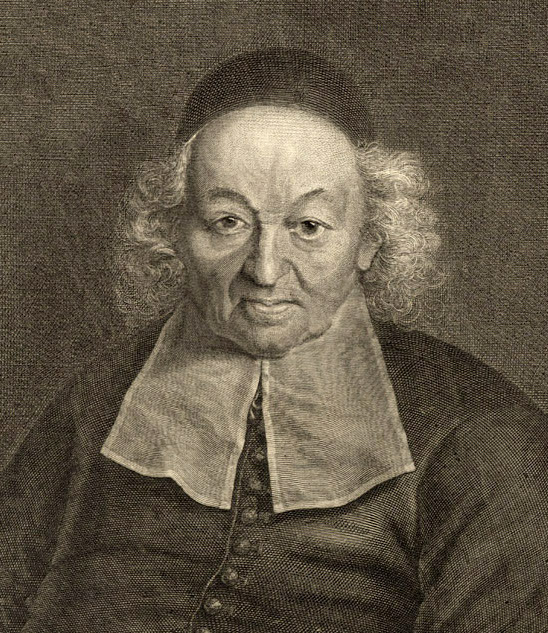
Ismael Boulliau (source: Wikimedia Commons)
In his post The man who inverted and squared gravity, the noted historian Thony Christie writes:
the true originator of the [inverse square law] hypothesis, as acknowledged by Newton in the Principia, was the French mathematician and astronomer Ismael Boulliau…
Actually not in the Principia; the correct citation is to the Newton-Halley correspondence.
I disagree with awarding this accolade to Boulliau, for a number of reasons. First let’s summarize Thony’s argument with excerpts from his post:
[Boulliau] wrote several important mathematical works of which the most significant was his Astronomia philolaica published in 1645. In this work Boulliau, like Wren an early Keplerian, presented his version of the elliptical astronomy. It is here that we can find the earliest statement of the inverse square law [for gravity].
I’ve added “[for gravity]”; in context, this is clearly intended. Thony states further down that Kepler had already given the inverse square law for the propagation of light in his Pars Optica.
But already we have the first problem with the attribution: Kepler’s whirlpool force is not gravity.
Thony continues:
In his version of the Keplerian astronomy Boulliau argued that if this force existed it would not diminish in direct inverse ratio but in the inverse squared ratio and thus the law of gravity first saw the light of day. It should be pointed out that Boulliau did not accept the existence of such a force but he had introduced it into the contemporary astronomical discussion and we have already seen where it led. …
Boulliau argued by analogy that if Kepler’s planetary driving force existed then it too would diminish according to the inverse square of the distance travelled. History and Newton would prove him right against his own better judgement.
My second objection: Kepler explicitly made this observation about the analogy with light in the Astronomia nova. And he resolved it! Boulliau simply repeats Kepler’s observation, but either Boulliau missed the resolution, or ignored it, or disbelieved it, or failed to understand it. So if this observation counts as having “inverted and squared gravity”, then Kepler gets the honors.
Thony has already pointed out a third objection: Boulliau did not believe in Kepler’s whirlpool force. Like many astronomers of the time, he strongly objected to introducing forces into astronomy, period. From the preface to the Astronomia philolaica: “From physical conjectures we draw back, for they do not suffice, nor is there great force in them.”
Curtis Wilson’s paper “From Kepler’s Laws, So-called, to Universal Gravitation: Empirical Factors” (Archive for History of Exact Sciences, 6:2 (1970), p. 89-170) has 17 pages on Boulliau’s theories. The approach is entirely geometrical. Uniform circular motion figures heavily. From philosophical a priori argument, Boulliau concludes that planetary orbits must be given by the intersection of a cone with a plane—i.e., must be elliptical. Kepler’s second law is replaced with a new one. Embarrassingly for Bouilliau, Seth Ward showed that Bouilliau’s speed law was equivalent Ptolemy’s old equant, adapted to the ellipse. (Bouilliau had explicitly, and incorrectly, denied this possiblility.)
Finally, what about idea that Newton ascribed the law to Boulliau? We may wonder at Newton giving away credit for this to anyone. A closer look at Newton’s two letters to Halley, dated June 20 1686, puts a different spin on this. The context, of course, is the famous Hooke-Newton priority dispute over the inverse square law for gravity.
The burden of both letters: Hooke does not deserve any credit! Newton goes on for pages and pages with his complaints. He claims to have had the idea independently of anyone else. He certainly does not say he got it from Boulliau. Grabbing any ammunition he can, he writes:
For as Borell wrote long before him that by a tendency of ye Planets towards ye sun like that of gravity or magnetism the Planets would move in Ellipses, so Bullialdus [Boulliau] wrote that all force respecting ye Sun as its center & depending on matter must be reciprocally in a duplicate ratio of ye distance from ye center, & used that very argument for it by wch you, Sr, in the last Transactions have proved this ratio in gravity. Now if Mr Hook from this general Proposition in Bullialdus might learn ye proportion in gravity, why must this proportion here go for his invention?
N.B.: Newton does not say that Boulliau applied his proposition to gravity. Maybe Hooke did, says Newton. Now, the idea of an inverse square law, of any kind, goes back at least to Nicolas of Cusa (1401–1464). Kepler introduced it for light, and discussed it in connection with his whirlpool force. Boulliau merely repeated Kepler’s observation, but apparently without noticing that Kepler had already made it. Boulliau did not apply it gravity, indeed rejected celestial physics entirely.
Thony writes, in a comment:
The discussion between Boulliau and Seth Ward on the Keplerian Laws is thought to have been the source from which Newton drew his knowledge of Keplerian astronomy rather than Kepler’s own writings.
Thony doesn’t give a citation for this, but let’s grant it. Newton’s letter does show that he was aware of this passage in Boulliau’s Astronomia philolaica. To jump from this to the claim that that’s where “the law of gravity first saw the light of day” … That stretches things quite bit. Well past the breaking point, in my opinion.
I’ve been negative till now, so let me offer a defence of Thony’s title. It’s a mild form of clickbait. Thony wanted a punchy header for a fun fact from the history of science. The piece itself provides all the pleasures that Thony’s posts always enjoy: interesting content told exccptionally well. Other than the title (which I am probably taking too literally), my only complaints lie with a couple of passages. Boulliau did not originate the hypothesis, nor did Newton acknowledge that, nor does the Astronomia philolaica contain the earliest statement of the law. But the Astronomia philolaica may have contributed to the discussion of the law, and in any case it played an important role in astronomy between Kepler and Newton.


 Diagonal Argument