
Latitudes
First thing to note about Ptolemy’s latitude theory: its decoupling from the longitude theory. For longitudes, one projects the orbits into the ecliptic plane. The actual speeds will differ from the projected speeds. However, the effect is small because the inclinations are fairly small (see the table below), and Ptolemy’s longitude computations ignore it. The latitude algorithms use the longitude as an input.
| Planet | Inclination (°) |
|---|---|
| Mercury | 7.0 |
| Venus | 3.4 |
| Earth | 0 |
| Moon | 5.1 |
| Mars | 1.8 |
| Jupiter | 1.3 |
| Saturn | 2.5 |
For the Moon, the theory essentially matches modern astronomy. Recall that the nodes of the orbit are where its inclined plane intersects the ecliptic. The Moon’s orbit is inclined at about 5° to the ecliptic, so we simply put the whole mechanism of the longitudinal theory on a plane with that inclination. The line of nodes rotates slowly in the opposite sense to the Moon’s revolution (technical term: retrograde), taking almost 19 years for a complete rotation. That’s the whole story. This part of the lunar theory goes back to Hipparchus, who probably got his parameter values from the Chaldeans (aka Neo-Babylonians).
The combined solar-lunar theory functions as an eclipse predictor1: lunar eclipses occur when we have Sun-Earth-Moon lined up perfectly in that order, solar when we have Sun-Moon-Earth lined up. In either case the Moon must be at one of its nodes, so that its latitude, like the Sun’s, will be 0°.
Turning this around, lunar eclipses provide good fodder for perfecting the lunar theory. As Pedersen notes:
Only observations of lunar eclipses remain unaffected by parallax, since the passage of the Moon through the shadow of the Earth is an objective phenomenon and virtually the same for all possible observers. In this respect lunar eclipses are unlike eclipses of the Sun. Thus the most suitable observations to be used as data for a lunar theory are eclipses of the Moon
—Pedersen (p.161)
And thanks to the perceived astrological importance of these events, Ptolemy (and probably also Hipparchus) could draw on hundreds of years of eclipse data.
In contrast to the lunar case, the Ptolemaic theory of planetary latitudes is beset with complications, so much so that he felt impelled to defend it:
Now let no one, considering the complicated nature of our devices, judge such hypotheses to be over-elaborated. For it is not appropriate to compare human [constructions] with divine… Rather, one should try, as far as possible, to fit the simpler hypotheses to the heavenly motions, but if this does not succeed, [one should apply hypotheses] which do fit… We should not judge “simplicity” in heavenly things from what appears to be simple on Earth…
—Toomer (Bk 13 §2)
Even so, Ptolemy simplified his latitude theory in the Planetary Hypotheses, making it more accurate as a bonus. Swerdlow details the changes. (He also discusses the intermediate version of the Handy Tables.)
The diagram below displays the essential features of the latitude models. The deferent is tilted with repect to the plane of the ecliptic, intersecting it along the line of nodes. The epicycle is also tilted.
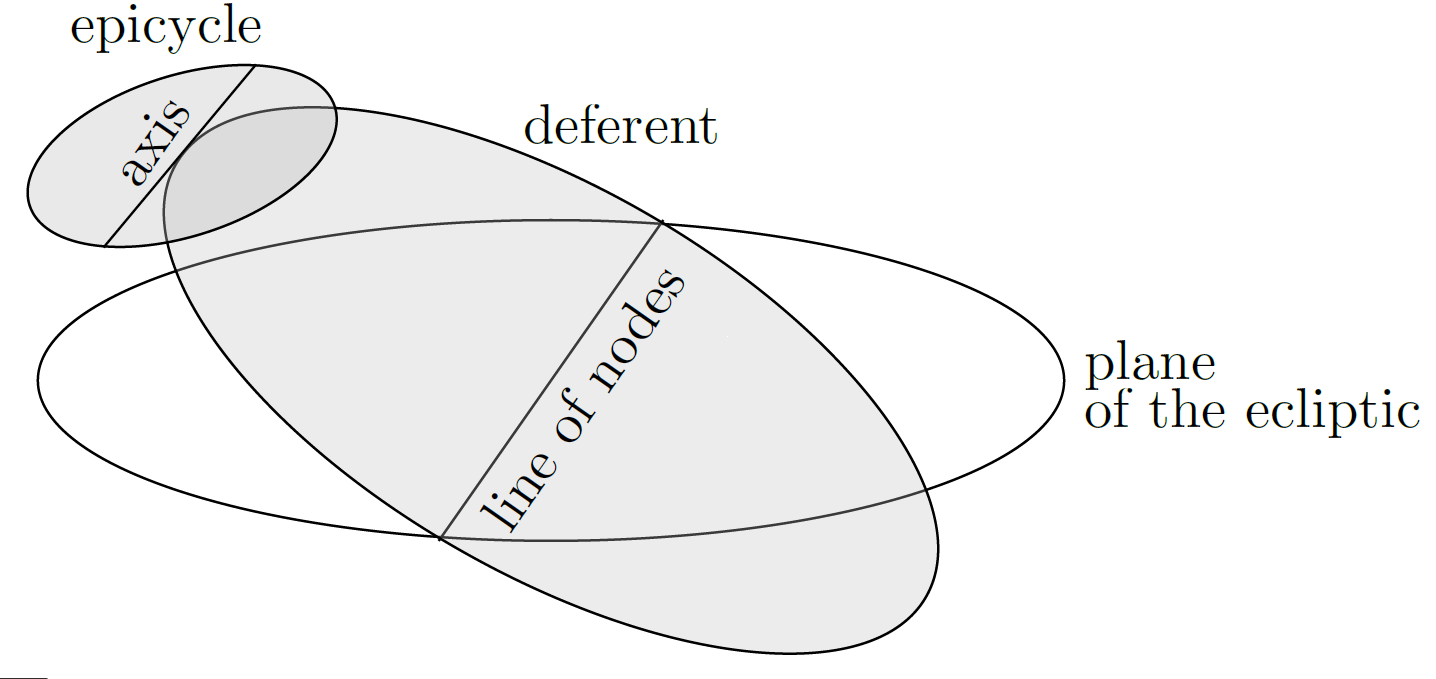
The details differ for the outer and inner planets. Consider first the outer planets. Following the Kepler-to-Ptolemy transformation, the deferent represents the planet’s orbit, so its inclination should be given by the table above. The epicycle represents the Earth’s orbit, so it should always lie in the ecliptic plane—or rather, be parallel to it, after the switcheroo described in post 2.
For the inner planets, we have deferent = Earth’s orbit and epicycle = planet’s orbit, so the deferent should lie in the ecliptic plane with the epicycle tilted according to the table.
Next we look at the system in the Almagest, outer planets first. The deferent is tilted, at a fixed angle, and the line of nodes has a fixed direction (unlike the Moon’s). So far so good. But the epicycle, instead of remaining parallel to the ecliptic plane, oscillates about the axis shown in the diagram above. When the epicycle’s center passes through the nodes, the tilt is 0, so at least then it lies in the ecliptic plane.
For the inner planets, the deferent’s tilt no longer has a fixed angle, but oscillates about the line of nodes. The epicycle also oscillates about the axis, as with the outer planets. But the axis itself rocks back and forth, instead of remaining parallel to the ecliptic plane. To quote Pedersen (p.370), “[the] combined effect is to give the epicycle a heaving, pitching, and rolling motion like that of a ship in a heavy sea.”
Ptolemy arranges these oscillatory motions using “a curious mechanical device” (Pederson; Swerdlow: “a curious cross between a mathematical and mechanical model”). He hooks the end of the axis to a little spinning wheel, perpendicular to the epicyle. For the inner planets, he does the same for the line of nodes (the wheel now perpendicular to the deferent). Thus we need three wheels for each inner planet.
What accounts for this Rube Goldberg apparatus? Pedersen excuses it this way:
…it is almost as simple to calculate the heliocentric latitude of the planet according to Copernicus as it was to compute the geocentric latitude of the Moon according to Ptolemy… But to transform the heliocentric latitude to a geocentric system of reference is no easy task in the Copernican system. To calculate geocentric latitudes directly would be even more difficult—and this is what Ptolemy strives to do.
Dreyer suggests something similar but more specific:
That Ptolemy found the latitudes of the planets extremely troublesome is not strange when we remember that their lines of nodes pass through the Sun, while Ptolemy had to assume they passed through the Earth… In no other part of planetary theory did the fundamental error of the Ptolemaic system cause so much difficulty…
—Dreyer (p.200)
But these explanations don’t hold water; as we’ve seen, the Kepler-to-Ptolemy approach results in a simpler scheme.
Another suggestion traces the difficulty to Ptolemy’s use of the mean Sun instead of the true Sun. This can account for some of the variable inclinations some of time. But as Swerdlow details, the main culprit is poor data, just as with the Mercury theory. Swerdlow, after dismissing the “mean Sun” explanation:
Rather, the cause is the very strength of Ptolemy’s mathematical astronomy, its rigorous empiricism, for the variable inclinations are directly determined, indeed dictated, by [observations]…
Further, the method of deriving the inclinations, the computation itself, is so sensitive to small imprecisions and roundings that even with accurately observed latitudes, it would still be difficult to find the inclinations exactly.
Swerdlow outlines the observational obstacles:
Ptolemy’s derivations require observations of the planet at opposition and as near as possible to conjunction, with the center of the epicycle at each of the limits of latitude, but these conditions occur simultaneously only rarely… And while observations at opposition may be made with the planet well above the horizon, with clearly visible reference stars if such were used in any way, observations near conjunction, thus shortly after first and before last visibility, must be made low on the horizon, possibly without suitable reference stars, and affected by refraction.
Swerdlow (p.47)
Recall that at conjunction, the Sun and the planet share the same longitude. You can’t see the planet with the Sun high in the sky, so near conjunction these observations must be made shortly after sunset or shortly before sunrise. For inner planets, conjunctions are all you have.
Ultimately Ptolemy threw all these complications into the trash can. Swerdlow:
The Planetary Hypotheses may be considered Ptolemy’s last word on latitude theory, in which he finally got nearly everything right… For the superior planets the epicycles now have fixed inclinations to the eccentric parallel to the ecliptic… It is easy to show that [the inclinations given for the outer planets] produce quite accurate latitudes at conjunction and opposition at the limits…
Ptolemy had already fixed the inner planet theory in the Handy Tables, and this is carried over to the Planetary Hypotheses. The Planetary Hypotheses also contains rather accurate values for all the inclinations. Swerdlow continues:
How Ptolemy made these changes, he does not say except to remark that by continuous observations he has made corrections, compared to the Almagest… So one must conclude that he corrected the theory of latitude… from his own observations… However Ptolemy did it, he got it right2.
[1] The NASA website Eclipses and the Moon’s Orbit has an informative treatment from the modern perspective.
[2] Hamm offers several alternative explanations for the changes. Ptolemy may have wanted to give a simpler account; he may have had in mind the difficulties of fabricating mechanical models; he may have reverted to a pre-Ptolemaic latitude theory. (There is some evidence in the history of Indian astronomy for such a theory.)


 Diagonal Argument