
We’ve seen the basic plan for an outer planet in post 2:

The deferent represents the planet’s orbit about the Sun, the epicycle the Sun’s orbit about the Earth (in the geocentric frame). The rotating vector 


As the Sun’s orbit is actually a Keplerian ellipse, we should use eccentric circles with equants for the epicycles. Ptolemy does not do this. In effect, he replaces the true Sun S with the mean Sun S. He retains the eccentricity and equant only for the deferent. As a result, the epicycle vector 
| Planet | Eccentricity |
|---|---|
| Mercury | 1/5 |
| Venus | 1/147 |
| Earth | 1/59 |
| Moon | 1/18 |
| Mars | 1/10 |
| Jupiter | 1/21 |
| Saturn | 1/18 |
The final model looks like this:
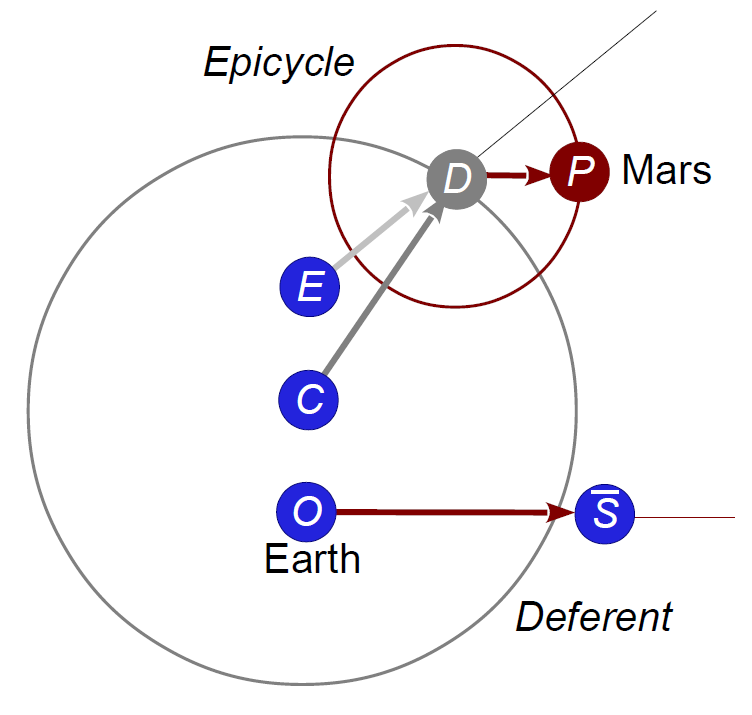
Model for an Outer Planet
The vector 

Above I said that “in effect” Ptolemy did these things, but of course he didn’t look at it this way. He didn’t regard the epicycle as representing the Sun’s orbit; he had no reason to make the lengths of
One more difference between my description and Ptolemy’s presentation: he deals with the angle between


 Diagonal Argument