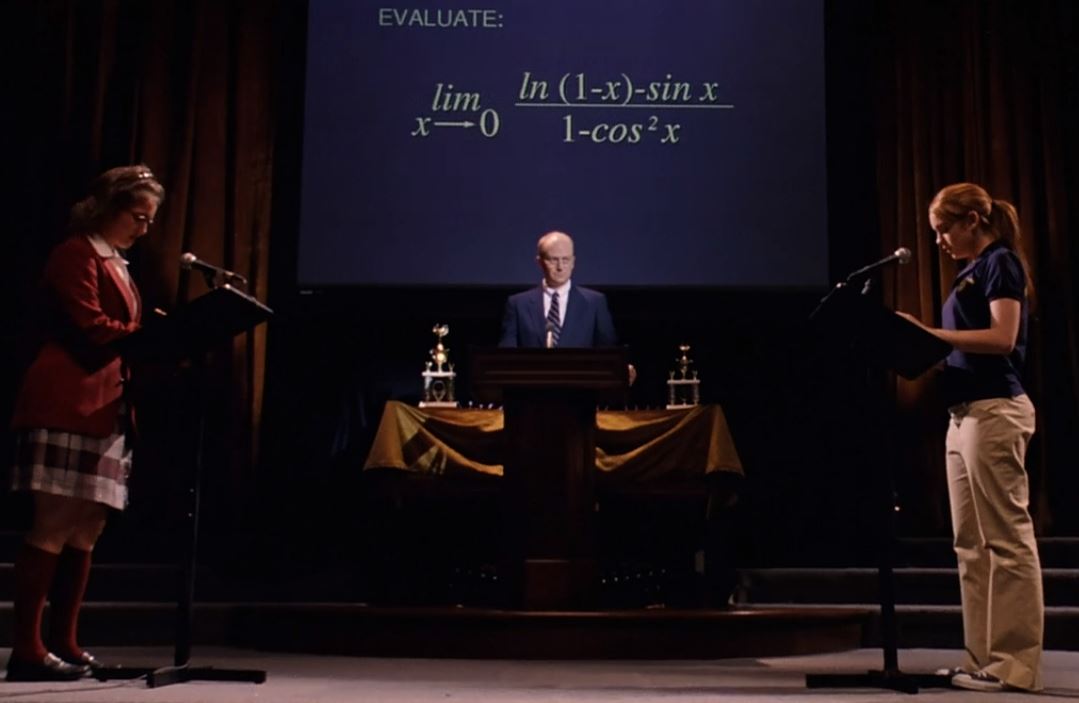
I’ve seen the meme (‘The limit doesn’t exist. The limit doesn’t exist!’) many times, but I don’t think that I’ve ever seen the limit in question before. So now I finally know what she’s talking about.
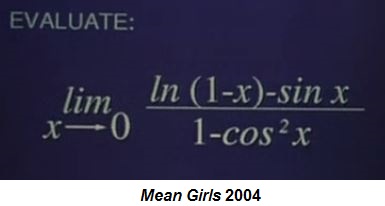
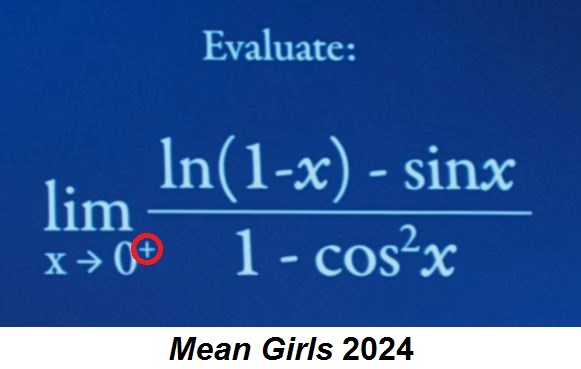
Of course, sometimes making a limit one-sided will make it exist! In the textbook that I teach from, the 2004 limit would be said to not exist, while the 2024 limit would be said to be −∞. If this scene is based on a real competition, then someone should look up what their rules are.
(The formatting is better this time. I’d say that they remembered the backslashes, except that so much is still wrong with the formatting that I know that they didn’t use TeX at all.)
I guess in ℝℙ1, the limit would be ∞ in both cases. I expect that in ℂℙ1 it wouldn’t exist, though you’d need to pick a branch of the logarithm to make the expression meaningful.
“The limit does not exist” is the winning answer in both movies, so I guess we’re allowing only elements of ℝ.
In ℂℙ¹, the limit is still ∞. If we’re just adjusting the codomain (from ℝ to [−∞, ∞] to ℝℙ¹ to ℂℙ¹), then as soon as the limit exists in one, it continues to exist in the next. But even if we generalize the domain to a neighbourhood of 0 in ℂ, the limit is still ∞, because we’re still looking at ~−2𝑥/𝑥².



 Diagonal Argument
I’ve seen the meme (‘The limit doesn’t exist. The limit doesn’t exist!’) many times, but I don’t think that I’ve ever seen the limit in question before. So now I finally know what she’s talking about.
Of course, sometimes making a limit one-sided will make it exist! In the textbook that I teach from, the 2004 limit would be said to not exist, while the 2024 limit would be said to be −∞. If this scene is based on a real competition, then someone should look up what their rules are.
(The formatting is better this time. I’d say that they remembered the backslashes, except that so much is still wrong with the formatting that I know that they didn’t use TeX at all.)
Good point!
I guess in ℝℙ1, the limit would be ∞ in both cases. I expect that in ℂℙ1 it wouldn’t exist, though you’d need to pick a branch of the logarithm to make the expression meaningful.
“The limit does not exist” is the winning answer in both movies, so I guess we’re allowing only elements of ℝ.
In ℂℙ¹, the limit is still ∞. If we’re just adjusting the codomain (from ℝ to [−∞, ∞] to ℝℙ¹ to ℂℙ¹), then as soon as the limit exists in one, it continues to exist in the next. But even if we generalize the domain to a neighbourhood of 0 in ℂ, the limit is still ∞, because we’re still looking at ~−2𝑥/𝑥².
You’re right. I plead brain-fog. Somehow I was thinking about limx→∞ instead of limx→0.
I fell into the same trap when I first read your comment (which is why it took me 3 days).